Flat feet (pes planus) affects about 30% of the population, and most people with it have no pain at all. The problem starts when flat arches cause overpronation — the inward rolling of the foot that strains everything from the fascia to the knees to the lower back.
The right orthotic corrects that inward roll mechanically with every step. Here are the five best orthotics for flat feet in 2026, from OTC options that work surprisingly well to the custom route when you need it.
Buy this if
- You have diagnosed flat feet or overpronation
- You get arch or heel fatigue and want an OTC option before considering custom orthotics
Skip it if
- You have high arches, this is a different support profile entirely
- Your pain is concentrated in the forefoot rather than the arch or heel
What to look for
How we choose
We look for arch support rigidity appropriate for flat feet and overpronation specifically, rearfoot control, and how well a design fits into everyday shoes without needing extra room — weighing independent credentials like APMA acceptance over a brand's own marketing claims.
Our rankings reflect editorial judgment based on that evaluation, not a clinical trial. Significant overpronation or pain is worth a podiatrist evaluation for a custom orthotic recommendation.
The 5 best options in 2026

The polypropylene shell provides genuine motion control without the bulk of a custom device — a strong option for mild to moderate flat foot with overpronation.
- Polypropylene shell provides real motion control
- #1 prescribed OTC orthotic by podiatrists
- Dual-layer cushioning
- Anti-microbial top cover
- Takes a week to break in
- May feel too firm for first-time orthotic users
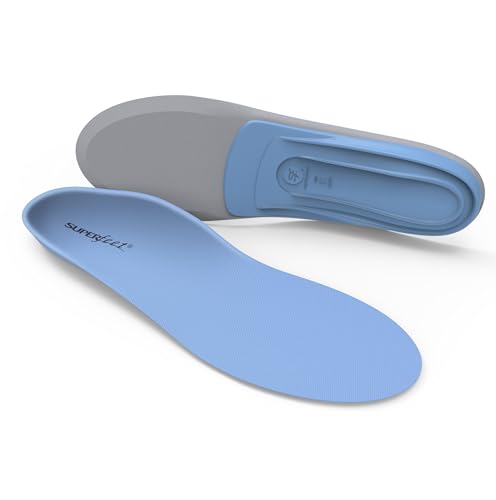
Superfeet Blue is specifically designed for medium arches and flat feet — different from the high-arch Green. Lower profile with a moderate arch height that fits better in lower-volume shoes and provides the support without overcorrecting.
- Designed specifically for flat feet
- Lower profile fits more shoes
- APMA accepted
- Reliable Superfeet quality
- Less aggressive correction than Powerstep
- Higher volume than you might expect

Running-specific orthotic designed for runners with flat feet who need pronation control during high-impact activity. Lighter and more flexible than general-purpose orthotics while still providing the arch support needed.
- Designed for running
- Light and flexible
- Good for high-mileage use
- Affordable
- Less rigid than daily-wear options
- Replace every 300-400 miles
Wide-footed patients with flat feet often give up on orthotics because standard sizes don't fit. The Superfeet WideGreen provides the same stabilizer cap and deep heel cup in a wider heel and broader arch that accommodates 3E-6E wide feet properly.
- Proper fit for wide feet
- Same quality as standard Superfeet
- Available in full size range
- Only works in wide shoes — won't fit standard width

For moderate to severe flat foot deformity causing significant pain or gait problems, custom orthotics cast from your foot provide correction that no OTC product can match. Often covered by insurance with a podiatry prescription. The long-term investment that OTC products are bridging toward.
- Precisely matched to your foot anatomy
- Insurance often covers with prescription
- Lasts 3-5 years
- Most effective option for severe cases
- Requires podiatry appointment
- $300-600 out of pocket without insurance
- Takes 2-3 weeks to receive
The bottom line
Powerstep Pinnacle is the right starting point for most people with flat feet — it provides genuine motion control at an accessible price. If you have wide feet, go Superfeet WideGreen. If OTC orthotics haven't resolved your symptoms after 6-8 weeks, the custom orthotic route through a podiatrist is worth the investment.
Flat feet without pain are not a problem that needs fixing. If your flat feet aren't causing symptoms, no intervention is necessary.
Want a personalized recommendation?
A podiatrist can fit you for exactly the right product combination for your foot type.